Welcome back to An Article I Read, where I summarize a scientific article relating to female orgasm (check all the past ones out HERE). This article was recommended to me by Mark, a person I recently connected with online through our mutual orgasm interests. You can see some of Mark’s writing at this blog. We are both interested in the physical qualities and markers related to orgasm, but where I’ve mostly been following specifically female orgasm, Mark has focused a lot on the male multiple orgasm. That in no way fully encompasses Mark’s work and depth of knowledge. In fact, I’ve learned so much from our discussions, and I will be posting about it in the near future. All that to say, Mark pointed me to this article because it is often used among certain crowds as evidence of non-genital female orgasms. I mean, I gotta review it, right?
“A Case of Female Orgasm Without Genital Stimulation.” J. Pfaus, Karolin Tsarski. Sexual Medicine. Volume 10, Issue 2, April 2022, Page 100496. Published 24 February 2022 (and accompanying video)
Lucky for you, this is published in an open access Journal called Sexual Medicine, and you can read the whole thing for free HERE. There is also an accompanying video showing the woman who is the subject of this case study, Karolin Tsarski (who is also an author on this paper), getting her blood drawn and having the 5-minute orgasm from this study. Strangely, I watched it when Mark sent them to me a several months ago, but now this link that is listed in the free article says is not available anymore. However, I eventually found it again!
So, I will do a full summary of the article below, but I first want to give an overview (turned out not to be as brief as I would have liked) that is full of my own opinions and also full of context for how I think this research fits into the larger picture of female orgasm in our world.
My Personal Overview
This article is a case study. Karolin Tsarski studied Tantra and yoga for years and claims she can have an orgasm without any genital or even any bodily touching whenever she wants and for however long she wants. So, she teamed up with researcher Dr. James G. Pfaus to see if they could physically confirm that these were ‘real’ orgasms. Although the authors said that, “orgasms are accompanied reliably by reflexive activation of pelvic floor muscle,” they thought the artifacts caused by other body movement when recording those pelvic floor muscle contractions would make it too difficult.
So, basically, the authors chose not to attempt checking for the one and only marker for orgasm that is pretty universally agreed to be a marker of orgasm - involuntary pelvic muscle contractions. I have to admit that this is super disappointing. I understand it could be a challenge during some circumstances, but what scientific investigation isn’t, and honestly, it’s been done on many occasions. It’s certainly not impossible. Orgasm studies sooo often just don’t attempt to record pelvic muscle contractions, and for the love of all things - they are for real the only widely accepted marker for orgasm, and we would have sooo much more clarity if they just would.
Instead the authors chose to check the validity of her non-touch orgasm claims though recording hormone levels in the blood before and after a 5 minute non-genital orgasm, a 10 minute non-genital orgasm a week later, and 10 minutes of her reading a magazine as a control a week after that. They found a 25% increase in prolactin after the 5 minute orgasm, a 48% increase after the 10 minute orgasm and no increase after the reading control. They chose this method because there is some indication in other studies that prolactin increases after orgasm. So, the prolactin increase, these authors say, proves that Tsarski’s non-genital orgasms are ‘actual’ orgasms.
The problem is…prolactin increase doesn’t prove an orgasm occurred. Prolactin increase, despite having some association in past studies to claims of orgasms, is not linked, in any studies, to orgasms that have been verified through a check for the tell-tale involuntary pelvic muscle contractions. So the claimed orgasms that are said to be related to prolactin increase, may indeed not have all been orgasms. But that’s not even the biggest problem. There is also another complication that makes prolactin increase a weak - at best- marker for orgasm. Prolactin increase is related to other things that often happen during sex, arousal, and orgasm; including exercise, increased heart rate (HR), and nipple stimulation (prolactin is a hormone heavily related to breast feeding). So, I mean, it’s a hard sell to say that a spike in prolactin is a marker for orgasm because you can’t really call something a marker unless that thing (spike in prolactin), when you see it, is reliably and specifically associated to the thing it is marking (an orgasm). That’s not what’s happening here because a spike in Prolactin, when detected, could also mean a lot of other non-orgasm things could have occurred.
Also, I have reviewed 4 of the main studies that seem to always be referenced about prolactin being indicative of orgasm HERE - if you want a deeper dive.
The authors try to get around the fact that increased heart rate and physical activity could also cause increases of prolactin by asserting that Tsarski’s exertion during the orgasms should not be enough to cause an increase in prolactin on its own. However, I would argue that they may be oversimplifying and possibly being a bit disingenuous. If you watch the video of her orgasming, I dare say, it’s pretty physically intense. Granted she’s not running or anything, but she is in a constant state of tensing different parts of her body including her core - which is not an insignificant exertion and might increase the heartrate quite a bit. She was out of breath when she was done with her 5 minute orgasm. They also did not check/report her heartrate or oxygen uptake during her orgasms, so we actually don’t know how much exertion was happening and thus how it compares to other studies on prolactin and physical exertion.
Yet the authors argue that sexual activity isn’t something that would cause enough exertion to show increases in prolactin levels. They back that up with this study of male athletes’ prolactin levels after periods of cardio exercise - indicating a significant level of prolactin increase might need up to 60 minutes of low to moderate exercise. However Tsarski is neither a male nor an athlete, nor is she doing the type of exercise/exertion these men were doing. I’d argue it could be a stretch to compare them. The authors further try to support their statement with this study to assert how much exertion would actually happen during sex (obviously, they assert it’s not enough to increase prolactin). However, that article they cite has a very specific disclaimer in its abstract indicating it should not be used to support this type of generalization, saying “Large variations among subjects and among activities discourage use of a general equivalent activity for comparison, such as ‘two flights of stairs,’ to represent ‘sexual activity.’" (Bohlen 1984). So even the authors of the article they cite wouldn’t want them to use it that way, and again, Tsarski isn’t ‘having sex.’ She is ‘orgasming’ in a way that I would describe mimics an intense core workout for the entire time. And it is also of note that the cited article points out, “Maximum exercise values occurred during the brief spans of orgasm.” (Bohlen 1984), which is notable because the ‘sexual activity’ being investigated in this article is a 5 and a 10 minute orgasm.
To further drive home my point that the authors may be wrong in assuming Tsarski’s physical exertion alone couldn’t cause a rise in prolactin (thus assuming her prolactin rise is the sole result of having an orgasm itself - not the exertion), I will quickly present another prolactin/exercise study I found. This study, which you can read online (and here’s a site that specifically converts prolactin results from one unit to another - which you will need to compare this study with Tsarski’s results). The exercise paper finds an average of 94% prolactin increase at only 45 minutes of moderate running from athleticlly trained males (1 hour caused a whopping 178% increase). So Tsarski, who is a female, maybe not athletically trained, and exerting herself for 10 minutes in a different, and maybe more intense, way than these male athletes were, may be showing a 48% increase in prolactin due to, well, physical exertion…and not the orgasm.
So, this article in no way proves that prolactin is a marker for orgasm. It also doesn’t prove that Tsarski had an orgasm - as there was no verification of the tell-tale involuntary pelvic muscle contractions.
HOWEVER, I’m also not saying she is ‘faking.’ I am not negating that she had a unique, possibly quite pleasurable experience that is climactic in some way. Calling it an orgasm, though - particularly in what is supposed to be a scientific paper, is confusing and problematic. Despite popular belief, there is a physiologic response called orgasm that has a physiologic marker (rhythmic, involuntary contractions of the pelvic muscle) that has been studied and observed and is possible in males, females and intersex individuals. Orgasm is not just any pleasurable, climactic, spiritual or sexual experience one wants to call orgasm, and acting as if it is makes studying, understanding, and advising about an orgasm almost impossible.
Why does Tsarski’s experience have to be called an orgasm to have value? Why couldn’t this investigation simply observe and record her experience so that we know more about it? What does it do to blood levels? What about HR and Oxygen intake? What about brain activity? What about her pelvic muscle activity??? If she didn’t have the involuntary pelvic muscle contractions that mark orgasm, would it make her experience illegitimate or fake? Or would it just make it some type of climactic experience that is not an orgasm? Why would that be so bad? If someone wanted to learn how to do what Tsarski is doing and also wanted to learn how to have an orgasm, it may not be the same for both, so why automatically conflate them and continue to confuse the fuck out of women about what their body is ‘supposed’ to do or is capable of doing under different circumstances?
And might I add, on a very practical level, it’s a bit wild to even assume this is an orgasm because an orgasm is literally the involuntary muscle contractions that release the muscle tension and blood congestions built up by physical sexual arousal. First, it does not seem as if there was any physical sexual arousal built up that could be released. Secondly, to imagine that the muscles are continually contracting and releasing for 5 to 10 minutes seems unlikley and honestly probably painful - since long-continued pelvic contractions could be pretty intense.
What Tsarski experienced, however, is something. It’s certainly worth investigating and discussing, but conflating it with an orgasm is misguided and contributes to a convoluted understanding of orgasm.
A bit about the woman involved in this study
I want to take a quick minute to talk about Karolin Tsarski.
I’ll be honest, the video of her orgasming for this study looks like the most played-up faked porn orgasm I’ve ever seen. It feels wildly outrageous to me, and in general I feel very critical of endeavors that seek to tell women that they can orgasm in epic and unrealistic ways if only they would put in enough time, energy, practice, spiritual maturity, or whatever else is being sold. I think it’s ultimately confusing and harmful. So I very much wish that Tsarski would speak about this experience in a different way than calling it an orgasm.
However, I truly believe her heart is in the right place, and although it’s not my cup of tea, I think at its core, her brand of finding pleasure through connecting to one’s own body could be personally enlightening to people that want more of that energy/spiritual element. I did a somewhat deep dive on her. You can check out her website. She’s a holistic sexuality coach and yoga teacher who believes anyone, man or woman, can learn to have these same orgasms. She has online classes, retreats, and does personal training.
In this video an interviewer asks her if orgasm is only clitoral or if there are other options. Karolin tells her that’s one of the main reasons women come to her - because they say they only feel clitoral orgasm and they don’t, but want to, feel other types of orgasms. She says that most women only experience clitoral orgasm, and if you are one of these women, don’t put yourself down or feel bad as if you are not enough or you are experiencing something superficial. She then aligns that to a man worried that he only has orgasms from penile stimulation - which we would see as a silly worry - which I 100% agree with.
I LOVE that she acknowledges the ridiculousness of shaming women for ‘only’ being able to have clitoral orgasms (since I would argue that’s really the only kind there is). However, she does believe there are other kinds of ‘orgasms’, and at times insinuates, probably unintentionally, that clitoral orgasms are lesser. She at one point says the clitoral nerves give more localized sensation and are easier to awaken than more interior nerves and that vaginal nerves need to have a lot more time and a lot longer penetration to feel things. Both those things, to me, are harking back to the classic storyline that clitoral orgasm are somehow more ‘surface’/‘simple’/‘fast-food’ and other orgasms (‘vaginal,’ ‘non-genital,’ etc.) are more ‘full bodied’/‘complex’/‘gourmet meal’ and are only available to those that have a better or more nuanced bodily/emotional/spiritual understanding.
I’m super wary about those types of insinuations because it’s really just an updated version of Freud’s ‘clitoral orgasm are immature and vaginal orgasm are mature’ schtick. Despite the fact that there isn’t much evidence at all that “other” (non clitorally stimulated) orgasms even exist, Tsarski’s assertions are also problematic because even though it might not be the intention, it helps keep penetrative sex on a pedestal and promotes the idea that a regular orgasm is simply not enough, and we need to strive for something higher and more noble through unattainable levels of mental and spiritual mastery. For instance, she says the whole body is nerves, so actually you can orgasm from any touch, “if you are able to let go, basically you can just have an orgasm without even going to the clitoris or any other nerves in your genital area.. or no touch at all…”
Another video of her being interviewed on some kind of British TV, I think, gave me another take on her. In this Video she describes not enjoying sex when she first started having it - and being interested in it, but not understanding why it was supposed to be so amazing but wasn’t. Then she started Tantra and right before the video ends, it’s mentioned that her advice is to not have penetrative sex - just focus on the intimacy and enjoyment and expand from there. She, quite rightly, said we’re too limited on how we think of sex.
It made me see her in a bit of a different way. She’s just a woman like me and so many others that could not align the idea of what sex was supposed to be with the reality of it on our bodies. It’s the real and practical experience of, I suspect, the vast majority of females - and particularly females with male partners, and everyone is trying to address it in the best way we can. She and I come at it differently, but with the same hopes. And in a way, both trying to buck the status quo of penetrative P-in-V sex as the be-all-end-all of sexual experience.
All that to say - I will critique this study and critique the act of calling anything and everything an orgasm BUT I do appreciate a woman working towards the larger goal of helping women find a sexual life they feel good about - even if I disagree with some of the insinuations, assertions, and vocabulary. Honestly, I think it’s actually quite lovely to remind people that their whole body is full of nerves and that you can find pleasure in your body in so many ways…but it is inaccurate and misleading to say that you can orgasm through any kind of mental or physical stimulation/physical. It only adds to the mountain of confusion about our bodies and our sexual functioning that women are already trapped underneath.
The Detailed Summary
In these summaries, you can assume that anything I write is a genuine attempt to reflect what is said in the paper. I do my best to balance between detail and approachable language. My opinions, if I have any to add (and I ALWAYS do) will either be inside brackets likes these [ME:], or in a section headed in a way that clearly lets you know these are my opinions. All quotes are from this article unless specifically noted.
I’m also going to warn you that I’ve become pretty obsessed with detailing the Introduction section, including all the articles they cite. I’ve come to feel like this part of a research paper is of the utmost importance in understanding what the study is really about. Knowing how the authors justify their reasoning for doing the study and for the methods they use, and seeing what kind of articles they use for those justifications tells me so much about how this research fits in with the larger scientific discussion on the topic and how sensible and valuable this work really is.
You can check out the list of all the past 'A Journal Article I Read' Summaries HERE.
Introduction
Describing Orgasm
The authors start by defining orgasm as a “complex multimodal reflex induced typically by genital stimulation.” The stimulation, they say, activates pathways in the brain and spine that trigger unintentional/reflexive (sympathetic) “outflow” and “the inhibition of parasympathetic spinal circuits” in the lower part of the spine. “In women this can be achieved by stimulation of the external and internal clitoris, anterior cervix, nipples, and other erogenous zones in sensitive individuals.” They back this up by a citation of an article called, The whole versus the sum of some of the parts: Toward resolving the apparent controversy of clitoral versus vaginal orgasms. [ME: Pfaus, the main author of this article I’m reviewing is also the main author of this article he cites. It’s a review of what other people in a variety of disciplines have to say about lady-gasms and does not, in the article itself or in the articles it reviews inside it, include any physical evidence that a physical orgasm has occurred from stimulation of any of the ways listed above except from stimulation of the external clitoris. It is all just assertions and self-reporting].
The authors go on to say that although the ‘reflex’ (aka orgasm) is a ‘bottom-up’ (very loosely meaning that it’s the sensation at the nerve endings in the body that activate the process,) that it is also controlled ‘top-down’ (or loosely, from the brain). Specifically in that the brain plays a part in inhibiting and exciting the reflexive elements of physical arousal that lead to orgasm like blood flow and “the subjective ability to ‘let-go’ into orgasm when it is imminent.” They then list some of the brain areas identified as correlating with orgasm. This is followed by a statement that orgasm can be rated subjectively in terms of quality, type of sensory stimulation, affective experience and pleasure, and they cited 3 articles, all from the same author, and all focused on surveys of women about how their orgasm feels - with none of those including any physical check to corroborate what physical experience the women are actually describing.
Defending Prolactin Measurement as a Valid Marker for Orgasm
The authors admit that “orgasms are accompanied reliably by reflexive activation of pelvic floor muscles.” [ME: aka the involuntary rhythmic pelvic muscle contractions known to be a marker of orgasm]. However, they note that those and also changes in the brain that have shown correlation with orgasm in the past can be difficult to record properly when the body moves too much. Then they go into a discussion of how a “consistent, orgasm-induced surge of prolactin” into the bloodstream is a useful way to physically verify orgasms. This assertion is backed up by a citation of a 2013 study where a comparison was made between measured prolactin levels and women’s accounts of orgasm quality for intercourse induced orgasm only.
[ME: as always, there is not actual correlation in this study between a physical orgasm through measurement of the rhythmic involuntary contractions that are markers of orgasm and an increased prolactin level. It’s all based on women’s reports of orgasming during intercourse. At best, this is shaky ground for an orgasm study to stand on because a female orgasm during intercourse is an event that is highly culturally valued but statistically rare and there is a sensible possibility that a woman might say she orgasmed in this situation but did not physically orgasm. So - what I’m getting at here is that the results of this study do not provide any physical evidence to prove that a physical orgasm and prolactin increases happen together OR that someone could identify that an orgasm happened just from prolactin increase alone. I’m basically saying that the overall results of this study they cite - to back up their most important assertion- are inherently messy at best.]
They go on to discuss a bit about why an increase of prolactin might indicate orgasm. They assert that the surge of prolactin is indicative of the sudden inhibition of dopamine transmission at orgasm, and they back that up by citing 4 papers, the last 2 of which are both co-authored (not the main author though) by Pfaus - who is also the author of this paper we are currently reviewing. The first Pfaus paper is from 1992 called, Dopamine functions in appetitive and defensive behaviours that reviews previous studies and heavily cautions in the abstract, “Although neurotransmitter pathways may figure prominently in the control of certain behaviours, it is incorrect to think of neurotransmitters as having a single role in behaviour.” (Blackburn 1992). Pfaus’ second is a 2009 paper called Pathways of sexual desire, and reviews past animal and human papers about neurochemical and neuro anatomical systems involved in sexual excitation and inhibition in an effort to understand drug use in the treatment of HSDD (low sexual desire). None of the 4 papers actually focus on orgasm at all.
[ME: So, to clarify why these authors are looking towards prolactin to indicate orgasm: there is plenty of evidence that prolactin may increase once a person is satiated and that it is part of a group of events that sort of reverse the group of processes related to desire that precedes it - dopamine increase is one of these desire-related processes. This may relate to a variety of needs or desires including appetite, sleep, fight-or-flight mechanisms, sexual desire, and other pleasures. This is the basis for the idea that a prolactin increase indicates an orgasm -aka indication of physical satiation from the build-up of physical sexual arousal. However, there is currently no data specifically connecting an increase in prolactin to the pelvic muscular contractions broadly understood to be the only agreed upon physical marker of orgasm, AND there otherwise are a variety of other non-orgasm related reasons that a person may exhibit an increase in prolactin, so the idea that an increase in prolactin is a biological marker for orgasm is only a hypothesis and a messy one at that. It’s important to understand that the articles used as citations here might indicate the possibility that prolactin increase could be related to the satiation of sexual desire, but do not support the idea put forth in this paper that it can prove a physical orgasm occurred.]
Trying to Argue Body Movement or Exertion Won’t Contaminate the Results
The authors further try to support the use of prolactin increase as a good measurement to indicate orgasm by asserting that measuring it, unlike measuring for pelvic muscular activity or for particular brain activity, would be un-affected by body movement and thus more accurate. [ME: brain activity, like a prolactin increase, has also not in any way proved to be a good marker for orgasm, but that’s a whole other discussion].
The authors do note that low to moderate physical activity could actually affect measurement because physical activity itself also increases prolactin, but don’t believe it would compromise their measurements in this study because the exertion of sexual activity is not itself enough to raise prolactin enough to be concerning. They say it “usually requires a duration of more than 60 minutes at a sustained intensity of 75% VO2 Max to induce a significant increase in plasma prolactin levels. Sexual Activity to Orgasm has a reported energy expenditure of approximately 1.7 to 3.3 metabolic equivalent tasks (METs) depending on the sexual position and the latency to orgasm.” [ME: they use different units in that sentence -V02 Max and METs- that can easily be converted but were not for some reason. For reference 1.7 to 3.3 (METs) = 6% to 12% VO2 max].
[ME: The citation supporting that sexual activity has a low level of exertion might not be reliable - according to the authors of the cited paper themselves. The article has a very specific disclaimer in its abstract indicating it should not be used to support this type of generalization, saying “Large variations among subjects and among activities discourage use of a general equivalent activity for comparison, such as ‘two flights of stairs,’ to represent ‘sexual activity.’" (Bohlen 1984). That same abstract points out, “Maximum exercise values occurred during the brief spans of orgasm.” It’s notable that the ‘sexual activity’ being investigated in this article is a 5 and a 10 minute orgasm. And if you watch the video of the 5-minute one, I think it could be valid to equate what she was doing with 5 minutes of an isometric core workout. Her exertion does not visually seem to be insignificant - and they did not measure her exertion, so we can’t know for sure what affect it might have had on Prolactin levels. I speak about all this in a bit more detail in the ‘My Personal Overview” section above.]
The final paragraph of the introduction purports to support the idea of a ‘top-down’ orgasm, saying, “orgasms can also be induced without genital stimulation,” and that it’s long been known people can experience orgasms during sleep, after exercise, just by looking at something or fantasizing, and that paraplegics have been known to report ‘phantom’ orgasms. They say, “This suggests that the top-down control of orgasm can be activated on its own under certain conditions in sensitized individuals.”
The articles used to cite each of these claims of orgasms that happen without genital stimulation include:
SLEEP - A 1954 article called Observations on blank dreams with orgasms. It’s not so much an actual study but a Freudian focused psycho analysis opinion piece that starts with, “Current interest in blank dreams with orgasms has been initiated by the studies of Bertram D. Lewen, who traces such dreams to earliest recollections of nursing at the breast followed by sleep,” and goes on to introduce the rest of the article with, “Clinical evidence is presented which provides additional interpretations that may be attached to the forgetting of dreams, particularly when such forgetting is associated with blank dreams accompanied by orgasm.” (Kanzer 1954). So, it’s really just a psychoanalysis paper that includes patients that claimed to have orgasms during dreams they’ve forgotten, so it’s a wierd citation choice to me. Although I’ve gotten used to lady-gasm articles randomly adding in citations from super Freudian, obscure articles to back up their claims. Also, it certainly does not have any actual physical evidence that orgasms have occurred during sleep with no stimulation to the genitals at all.
The second article for backing up sleep orgasms is a study asking 245 women in college to fill out surveys as to whether they have had nocturnal orgasms and what kinds of things described the women (like a sexual liberal mindset, knowledge of nocturnal orgasms or sometimes waking sexually excited - for instance). About 27-44% said they had nocturnal orgasms depending on how the question was asked…but again, this was a study of claims of nocturnal orgasms. None of these occurrences were physically verified, and there certainly wasn’t clarity that these happened without some accidental or sleep-infused genital stimulation.
[ME: and just because you might be thinking it, a ‘wet dream’ doesn’t prove males have orgasms during sleep without genital stimulation either. An ejaculations' may have occurred, but that is a different thing physically than an orgasm, and even if an orgasm also occurred, do we know that there wasn’t some genital stimulation happening?]
EXERCISE - This cited paper was part of a large sexuality survey. A small % of women said they could orgasm during exercise. Core work was a big one, but again this study was not a physical observation that an orgasm was actually happening or that there was not physical stimulation of the vulva happening - as in…these might be orgasms caused by genital stimulation happening in a wierd way, like pressure of yoga pants on the vulva area during certain rhythmic core exercises instead of an orgasm happening with no genital stimulation.
IMAGERY OR FANTASY ONLY - As a breath of fresh air, this article does take some physical observations of women during claims of orgasm and also during just watching things with no genital stimulation. Unfortunately, again, they chose not to actually check for the rhythmic muscular contractions of orgasm and instead only checked for heart rate, breathing and pain tolerance (measured by increasing pressure on fingers). The problem is that all of those things increase wildly during arousal, but as of yet there’s no actual evidence that any of those can be used to mark when an orgasm happens. So this article can only really tell us that it seems women can become significantly aroused just from visual stimulation - which…cool, but doesn’t really help us here.
FOR PARAPLEGIC MEN AND WOMEN - this is a 1960 article that again is only claims of ‘Phantom Orgasm in the Dreams of Paraplegic Men and Women.’ It is not proving that parplegic people can have physical orgasms in their sleep, because we don’t really know what any of these people mean when they say orgasm - and we certainly can’t say that they had the physically known markers of orgasm.
My Humble Opinion/Introduction Wrap-up
[ME: aka the authors know that there are reflexive rhythmic muscle contractions that are widely understood in the scientific community as the marker of orgasm, but they choose not to use that to identify whether or not an orgasm has occurred here because past studies show that it can be difficult to record because of other body movements that occur during the orgasm. Instead they choose to record prolactin increase in the blood. They did this despite knowing that physical activity alone as well as other things like increased heart rate, and nipple stimulation, which all can happens in the lead up to orgasm, can also increase prolactin. They assert that those other things wouldn’t affect the prolactin increase enough to contaminate their measurements, but their basis for asserting that is weak at best. Plus, despite their assertions otherwise, prolactin increase is not shown to be a marker of orgasm in previous studies. It has only been correlated with accounts of orgasm in previous studies. There is no past research that gives physical evidence that the known reflexive rhythmic muscle contractions of orgasm are specifically associated with an increase of prolactin in a way that arousal and the physical activity of sexuality are not. In other words, there is no past research that tells us that simply testing prolactin levels can tell us that an orgasm happened. It cannot. If I were a cynical person, I might suggest that the authors used the prolactin test instead of checking for pelvic muscular activity because they were worried that actually testing for the known marker of orgasm would not give the result they wanted.]
Case Study
Study Background
Karolin Tsarski, a 33 year old woman is said to have, “developed the ability to attain and control the duration of a subjective orgasmic state without genital stimulation after a decade of yoga training initiated by her relative difficulty with vaginal orgasms due to vaginismus and other pain at penetration.” She describes learning things like body positions, breathing techniques, body locks, pelvic floor exercises, processes to release guilt and shame. Orgasm and sexual pleasure were not a forced goal but did reveal themselves over time, and now, “Ultimately, her whole-body orgasmic capability sensitized to such an extent that she not only overcame her vaginismus but was able to put herself into a continuous orgasmic state almost instantly and have it last for a long period of time.”
Now, the researchers are asking 2 questions. The first is how her Non Genitally Stimulated Orgasms (NGSOs) subjectively compare to her genitally stimulated orgasms (and orgasms she has that are stimulated in other ways). “The second, and perhaps more important question, concerned whether the orgasms were ‘real’ in the sense of being accompanied by changes in objective measures previously associated with orgasm”
Subjective Inquirey
To answer the first question she filled out a widely used scientific survey to assess the subjective qualities of a female orgasm. She filled this out for her NGSOs as well as her orgasms she had through other methods. “Subjectively, the NGSOs were as pleasurable as external or internal GSOs (eg, clitoral orgasms), and produced a relatively similar set of sensory experiences. However, her NGSOs were somewhat blunted in the affective domain (for feelings of emotional intimacy and ecstasy) relative to her other orgasms”
The graph below shows the results of Tsarski’s ratings for 6 varieties of her orgasm types. “Subjective orgasm ratings on the sensory, affective, and evaluative subscales of the ORS. The sensory domain consists of 13 adjectives that describe sensations of building, flooding, flushing, spurting, throbbing, and general spasms, for a potential total possible score of 65. The affective domain consists of 9 adjectives that describe emotional intimacy and ecstasy for a total possible score of 45. The evaluative subscale consists of 6 adjectives that describe pleasurable satisfaction and relaxation for a total possible score of 30.”
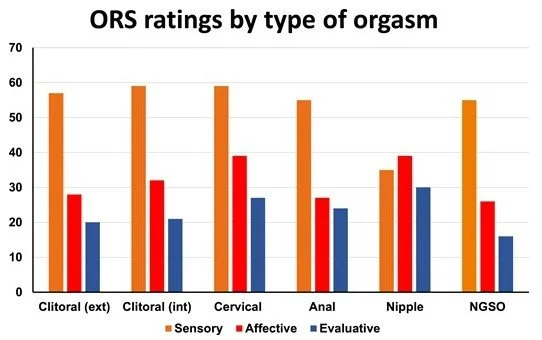
Figure 1 from “A Case of Female Orgasm Without Genital Stimulation,” Pfaus, J and Tsarski K 2022
Objective Inquiry Methods
To answer the 2nd question, they recorded hormone levels in the blood before and after a 5 minute non-genital orgasm, a 10 minute non-genital orgasm a week later, and 10 minutes of her reading a magazine as a control a week after that.
Specifically how each of the 3 tests worked was (and you can see a video actually taken during the 5-minute orgasm test HERE):
Karolin gets her blood drawn, sits for 10 minutes, gets on an exam table, immediately orgasms for 5 minutes - fully clothed and without touching her body. Watch the video. After this 5 minute orgasm, she is out of breath and sits down to get her blood drawn. She then sits calmly and gets another blood draw in 30 minutes. A week later she does the same thing, except this time the orgasm lasts 10 minutes. A week after that she does it again, except instead of orgasming, she just reads a magazine. This last one is the control.
There was no sexual stimulation or recreational drug use in between these weekly tests. She was also not on hormonal contraception.
The blood samples were stored in a -20 freezer and sent to a commercial testing facility that was blind to the conditions of the study. The commercial testing results were then sent to Tsarski herself, although in the paper they refer to her as simply “the woman (the second author),” and she “coded it so that the first author would be blind to the experiential conditions. After data analysis and figures were made, the code was broken to reveal each condition.” [ME: that’s a little strange that a person with so much vested interest in the results would be the one coding them, but I’m going to assume, since she is not a scientist, that she wasn’t expected to understand the raw results, so it’s as if she were blind to it - although the authors don’t specifically address why the results were sent to her to code for a future blind analysis.]
Objective Inquiry Results
They found a 25% increase in prolactin after the 5 minute orgasm, a 48% increase after the 10 minute orgasm, and both were still elevated in the blood taken 30 minutes after the orgasm. There was no increase after the reading control.
They also tested for 3 other hormones: follicle stimulating hormone (FSH), free testosterone, and luteinizing hormone (LH). “No changes were recorded in FSH or free testosterone. Interestingly, LH levels were higher, to begin with on the day of the 5-minutes NGSO (in a range suggesting a preovulatory surge), and the NGSO elevated LH levels by 45%, which remained elevated 30 minutes after. This elevation was not observed a week later when the 10-minutes NGSO was evaluated. However, the pre level of prolactin was elevated at this time relative to the other conditions, suggesting that the woman was in her luteal phase. Although free testosterone increased slightly 30 minutes after the book reading control (from 1 to 1.2 nmol/L), no increases in other hormone levels were observed for the control condition.”
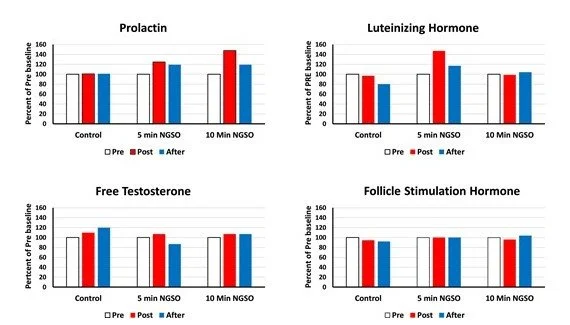
Figure 2 from “A Case of Female Orgasm Without Genital Stimulation,” Pfaus, J and Tsarski K 2022. Serum hormone levels as a percent change from the pre baseline during the 3 conditions (control, 5-minutes orgasm, 10-minutes orgasm).
Discussion
They again discuss the reasoning for the more unexpected increased levels of measured hormones and simply elaborate a bit more on what was said in the quoted paragraph above. They also reiterate their previous assertion that the prolactin surge, “is not likely to be affected by movement artifacts during orgasm.”
They also compare their results briefly with the prolactin/intercourse orgasm study they cited above in the introduction. They tell us that study proposed using “the post-orgasmic prolactin surge as an objective marker of orgasm quality” (Leeners 2013). They go on to further compare their results to that study, saying, “In fact, the prolactin surge following the 10-minutes NGSO was in the range reported by Leeners et al after 2 orgasms from partnered intercourse.” [ME: I’ll just refer you to my above criticisms of that study, and also wonder why these authors are not considering that a faked orgasm during intercourse with a partner might include a significant amount of physical activity and breath/vocal performance that just might have the possibility of inducing exertion related prolactin increase, and the longer and more excited the performance, the higher that prolactin increase might be. Just saying it’s annoying that these types of practical possibilities aren’t even discussed...]
Finally they make some assertions with cited studies about yoga and tantra training enhancing sexual arousal, desire, and satisfaction. These things have been refined into midfulness-based training for women with sexual disfunction and, tell us “Such training may well sensitize spinal and brain circuits for sexual climax and orgasm which should also feed forward to enhance neural mechanisms of sexual arousal and desire.”
Conclusion
I’m going to finish with a full text of this article’s conclusion.
“The ability to be orgasmic sensitizes with sexual experience throughout the lifespan. Although orgasms are typically activated by genital stimulation in a ‘bottom-up’ fashion, it is clear that they can be induced without genital stimulation in a ‘top-down’ fashion that reflects both sensory and motor memory and may be activated by dreams, fantasy, and erotic imagery, especially in women. The woman examined in the present case study was able to put herself into a relatively continuous orgasmic state after years of yoga and tantric training. The increase in prolactin observed in the present study was an objective response to orgasm and followed a lawful pattern of doubling as the time spent in orgasm doubled, similar to the results of a prior study in which women had 1 or 2 orgasms during partnered sex. These data suggest strongly that NGSOs are not ‘faked’ or partial orgasms, but rather reflect a top-down induction of a real subjective orgasmic state that includes objective hormonal changes.”